
Capturing the uncapturable
The Sahara is one of the most photogenic places on earth, and also one of the easiest to photograph disappointingly, its vastness and subtle light flattening into something ordinary in a careless shot. At Sahara Marvels we love seeing guests come home with images that actually convey the desert’s scale and beauty, and a few simple techniques make all the difference. You don’t need professional gear, just a little know-how and a willingness to work with the light rather than against it.
Photographing the desert well is less about equipment than about timing, composition and understanding how the light behaves on sand. Master those three and a modest camera will beat expensive gear used carelessly every time, because in the desert it is the light, not the lens, that does the heavy lifting. The good news is that the Sahara rewards even modest cameras and phones when you work with its rhythms rather than against them. This guide shares practical tips for the dunes, the light and the extraordinary night sky, the kind of small adjustments that separate a flat snapshot from an image that stops people in their tracks. Our Morocco Day Trips place you in the desert at exactly the hours when it photographs best.
Chase the golden hours
The single most important factor in desert photography is timing, and the desert’s best light comes at the edges of the day. In the low sun of early morning and late afternoon, the dunes glow gold and amber, and long shadows rake across the sand, revealing every ripple and curve. Shoot in this soft, directional light and the desert reveals its sculpted beauty; shoot at harsh midday and it flattens into glare.
This is why camel treks are timed for sunset and why sunrise over the dunes is such a photographic gift. Plan your best shots around these golden hours, be ready as the light changes quickly, and you’ll capture the desert at its most dramatic. The same dune photographed at noon and at sunset looks like two different places, one washed out and shapeless, the other sculpted and glowing. Working with the light is the whole game, and once you internalise it, everything else about desert photography gets easier. Our 9 Days Desert Tour put you in the dunes for both sunset and sunrise.
Composing the vastness
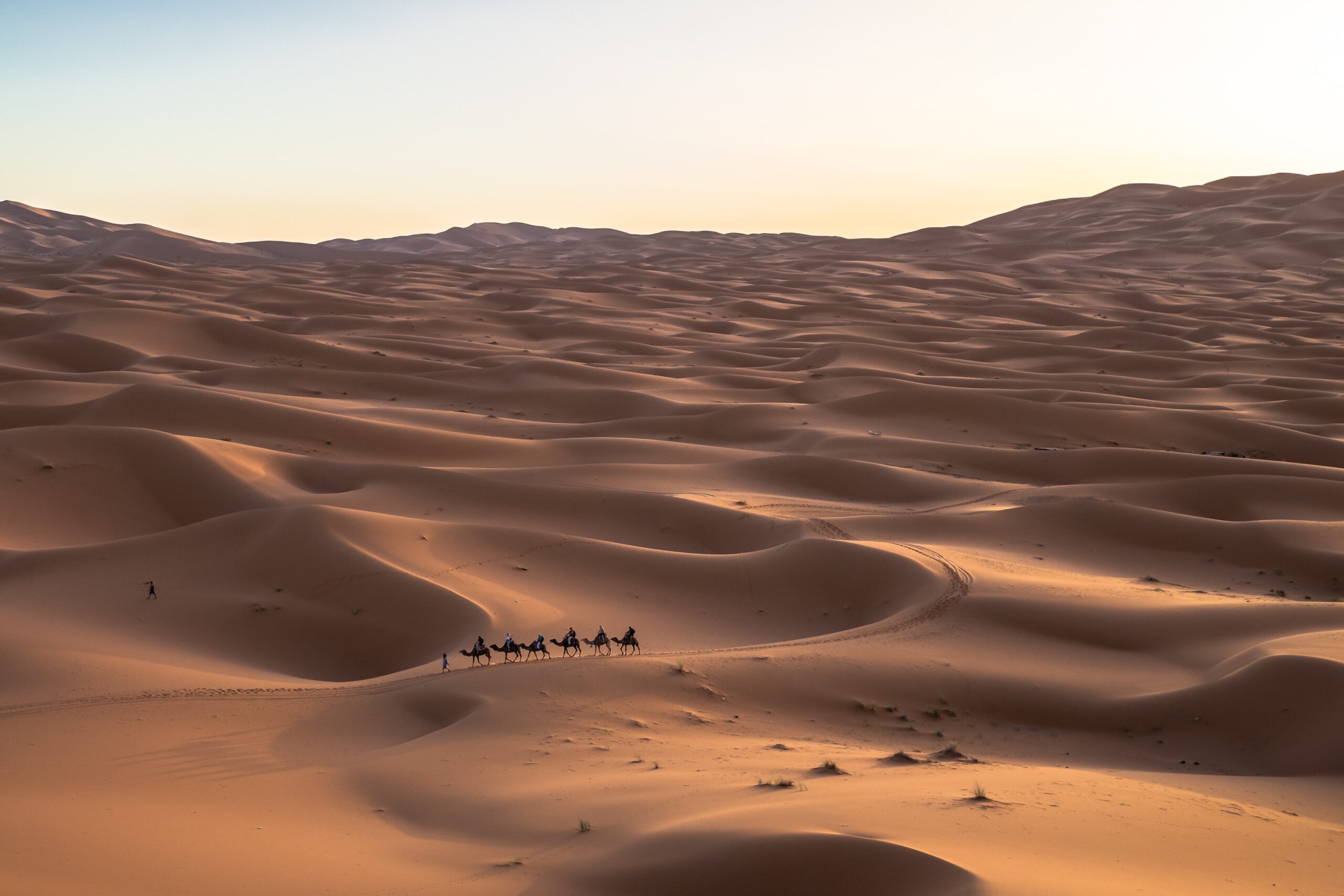
The great challenge of desert photography is conveying scale, because an empty expanse of sand can read as flat and featureless in a frame. The trick is to give the eye something to measure against. A lone figure, a camel caravan, a line of footprints or a distant camp provides a sense of scale that makes the dunes tower, transforming an empty picture into an epic one.
Composition also benefits from the desert’s natural lines. The sinuous crests of the dunes lead the eye through the frame, and placing that ridgeline off-centre, rather than dead through the middle, gives a stronger image. Look for the curve, the shadow, the contrast between lit and dark faces of the sand. A moment’s thought about composition turns a snapshot into a photograph worth framing. Our 3 Days Desert Tour from Fes offer endless dunes and caravans to compose against.
Shooting the night sky
The Sahara’s night sky is a photographic prize in its own right, and capturing it is more achievable than many think. Away from all light pollution, the stars and the Milky Way blaze overhead, and with a camera that allows long exposures and a steady support, you can record them in a way the eye alone can’t quite hold. Including the dunes or the camp as a silhouette in the foreground grounds the image, giving the vast starfield something earthly to anchor it and a sense of place that pure sky lacks.
A tripod is the key piece of kit here, since night shots need long, steady exposures; even a small travel tripod or a stable surface works. Experiment with your settings, and don’t be discouraged by early attempts, astrophotography rewards a little trial and error. Even a phone with a night mode can surprise you under skies this dark, capturing stars that would be completely invisible from anywhere near a town or city. The results are often the images travellers treasure most, precisely because they capture something the naked eye can sense but never quite hold. Our 6 Days Sahara Tour from Marrakech deliver some of the darkest, clearest skies on earth to shoot under.
Protecting your gear
The desert is beautiful but hard on cameras, so a little care keeps your gear working. Fine sand is the main enemy: it gets everywhere and can damage lenses and mechanisms, so keep your camera in a bag when not in use and be cautious about changing lenses in the open, especially if there’s any wind. A simple cloth and a blower brush handle the dust that inevitably arrives.
Heat and battery life are the other considerations. Cameras and phones drain faster in temperature extremes, so carry a power bank and spare batteries, and keep them somewhere insulated from the worst of the heat and cold. A few sensible precautions mean your camera is ready for the shot when the light is perfect, rather than clogged or dead at the crucial moment. Our Morocco Day Trips take you deep into the sand, where a little gear care pays off.
Beyond the dunes
While the dunes and the night sky are the headline subjects, the desert journey offers plenty else worth photographing. The kasbahs glowing in afternoon light, the dramatic gorges, the palm oases, the faces and daily life of the villages you pass, all reward a ready camera. Some of the most memorable images from a Morocco trip come from these incidental moments rather than the obvious set-pieces, the shot you didn’t plan often outlasting the ones you did.
A word on photographing people: always ask before taking someone’s portrait, both out of courtesy and because a willing subject makes a far better image. A smile and a gesture usually suffice, and the resulting connection often leads to a warmer photograph. Approached with respect, the human side of the journey yields some of its finest pictures, portraits with warmth in them precisely because they were freely given. Our 9 Days Desert Tour are full of subjects beyond the dunes, from kasbahs to daily life.
Bring home the Sahara with Sahara Marvels
Photographing the Sahara well comes down to timing, composition and a little care: chase the golden hours of sunrise and sunset, give the vastness a sense of scale with a figure or a caravan, shoot the extraordinary night sky with a steady support, protect your gear from sand and heat, and keep a camera ready for the kasbahs, gorges and daily life along the way. No professional kit required.
The Sahara Marvels team times every desert tour to put you in the dunes when the light is at its most magical, under some of the clearest skies on earth. To plan a trip that brings home images worthy of the Sahara, get in touch using the button below. Our 3 Days Desert Tour from Fes are your gateway to a desert that photographs as beautifully as it feels.
Frequently Asked Questions
How do you photograph the Sahara desert well?
Chase the golden hours of sunrise and sunset when the dunes glow and shadows reveal their shape, give the vast expanse a sense of scale with a figure, camel caravan or footprints, use dune ridgelines to lead the eye, shoot the night sky with a tripod for long exposures, and protect your gear from sand and heat. No professional kit is needed.
What is the best time of day to photograph the desert?
The golden hours of early morning and late afternoon are best, when the low sun makes the dunes glow gold and amber and long shadows reveal every ripple and curve. Harsh midday light flattens the desert into glare. This is why camel treks are timed for sunset and sunrise over the dunes is such a photographic gift.
Can you photograph the Milky Way in the Sahara?
Yes, the Sahara’s lack of light pollution makes it excellent for night photography. With a camera that allows long exposures and a steady tripod, you can capture the stars and Milky Way, ideally with the dunes or camp as a silhouette in the foreground. Even a phone with night mode can surprise you under skies this dark.
How do you protect a camera in the desert?
Keep your camera in a bag when not in use and avoid changing lenses in the open, especially in wind, since fine sand can damage lenses and mechanisms. Carry a cloth and blower brush for dust, and bring a power bank and spare batteries, as heat and cold drain power faster. A few precautions keep your gear ready for the perfect shot.
Useful Resources
For more background on the destinations and experiences mentioned in this guide, explore these authoritative resources: Essaouira — Wikipedia, Sahara — Wikipedia, Morocco — Wikipedia, and High Atlas — Wikipedia.
Book Your Morocco Trip
Ready to discover Morocco and the Sahara Desert? Get in touch with Sahara Marvels today and let our team design the perfect tailor-made Morocco journey for you.